Operation Sindoor, 7-10 May 2025
Four Days in May
What Operation Sindoor actually destroyed
A message to Pakistan, built from Pakistan’s own evidence: the air bases India cratered, the radars it blinded, the militant headquarters it flattened, and the gap in strength that Islamabad won’t show you. It’s also about why the “we won” story is the most expensive thing you’ll ever be told.
- Theatre
- Pakistan, PoJK and the northern Arabian Sea
- Mostly on
- Rawalpindi, Bahawalpur and Muridke
- Reading time
- 34 minutes
Congratulations, Pakistan, on winning the four-day war of May 2025. It was such a clean win that your air force has spent every month since putting out contracts to rebuild the air bases that were never hit, more than thirty of them so far. This piece celebrates that victory using your own paperwork, because the best witness against the Pakistani military turns out to be its own filing cabinet.
It started at 1:44 a.m. on 7 May 2025. Over the next four days India struck deeper into Pakistan than at any time since 1971: past the border districts, past Lahore, down to the approaches to Karachi. Officially, none of it touched the Pakistan Air Force. Its air bases, radars and command posts are all fine. That’s the official position, so hold on to it while you read. There’s a short quiz at the end, and a satellite marks it.
The evidence here comes from Pakistan, not New Delhi: a list of repair tenders from your own air force, a cabinet minister who went off script, funerals your own officers attended, and satellite frames your own channels put on air. You don’t have to trust India for any of it. You only have to trust the Pakistan Air Force’s procurement office, which for some reason has just had its busiest quarter in living memory.
Act I Nine buildings that fell down by themselves
The first night went after nine sites that India called “terrorist infrastructure”. Pakistan calls that a slander against nine peaceful religious retreats, which happened to have a training schedule, a resident commander and, at Muridke, a big front gate that reads MARKAZ TAIBA. Two of them mattered most: Markaz Taiba, the Lashkar-e-Taiba campus near Lahore, and Markaz Subhan Allah, the Jaish-e-Mohammed headquarters at Bahawalpur. Both were mosques, we’re told. Neither is standing.
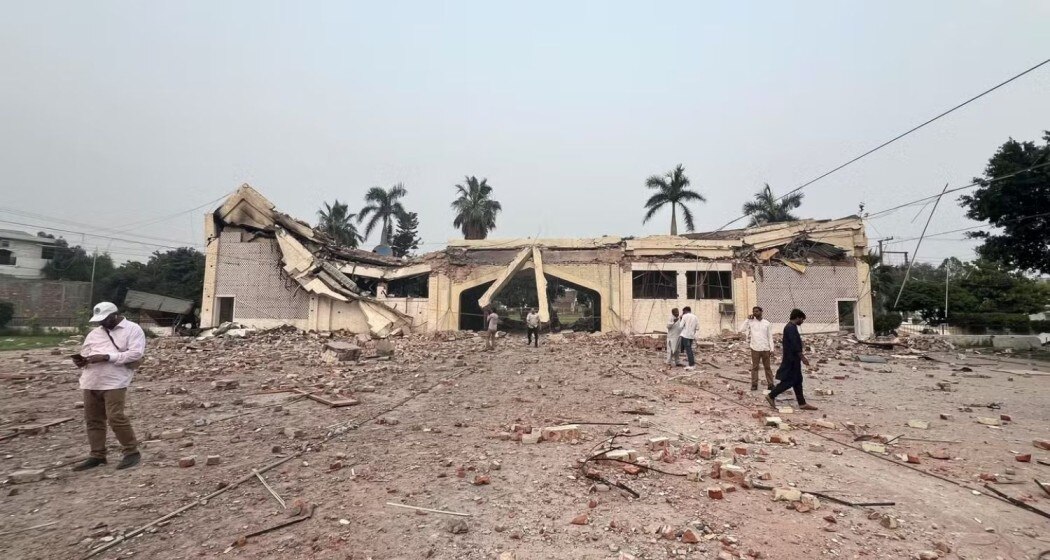
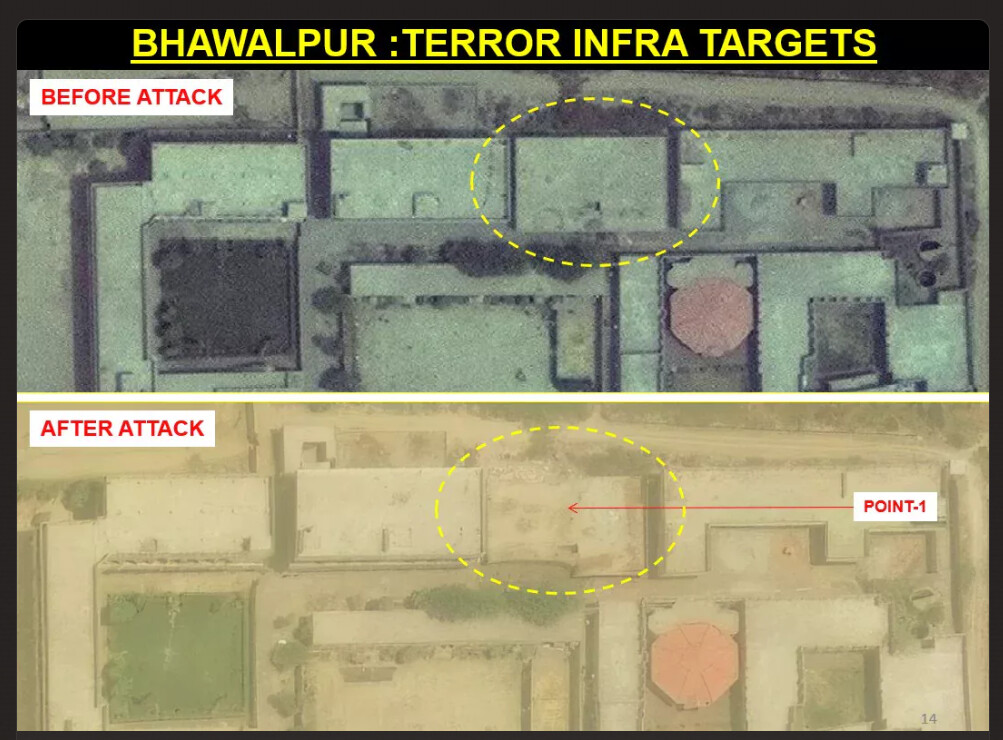
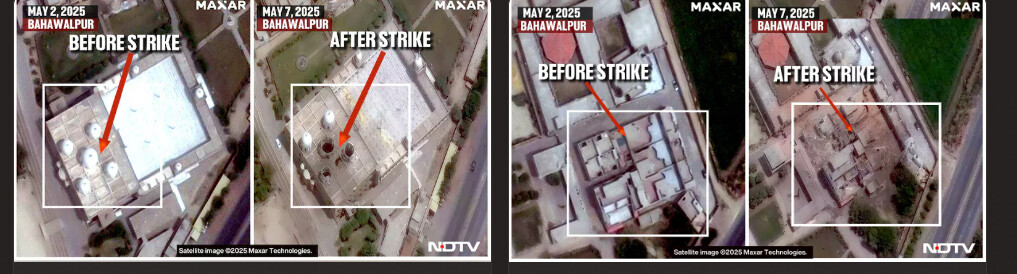
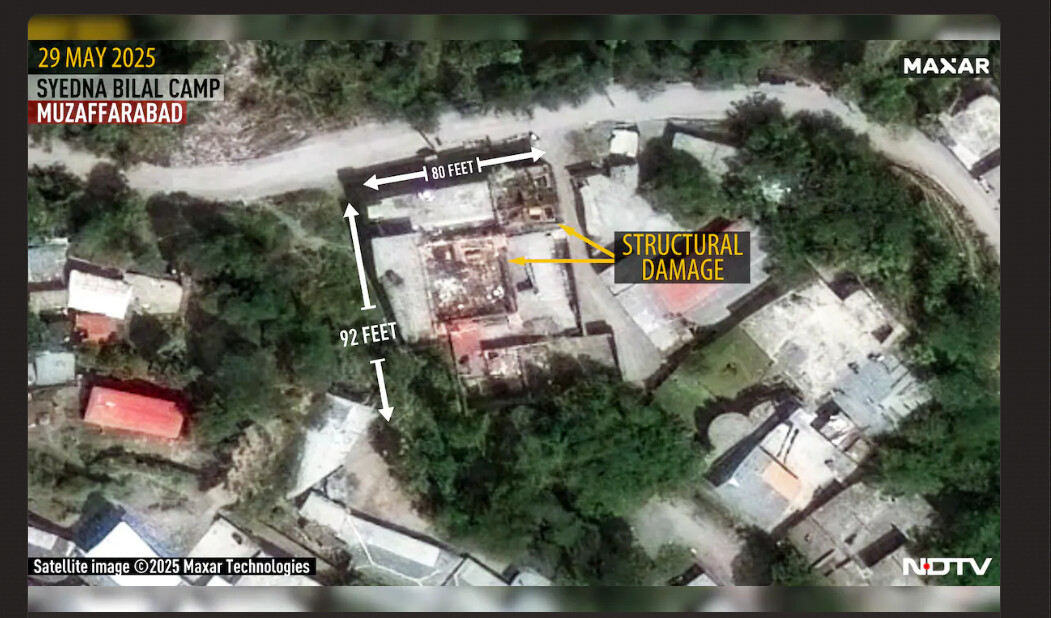
Maxar’s satellites photographed the result within hours, and Reuters showed it to the world. At Bahawalpur three domes were punched through and 2,100 square metres flattened. At Muridke the main block was simply gone, as if it had popped out for cigarettes and decided not to come back.
Going by the official line, nothing hit Muridke, so the four aim points marked inside it and checked against post-strike imagery must have been weather. Strange weather, though. It arrived at 600 knots, carried a guidance package and only hit buildings owned by Lashkar-e-Taiba.
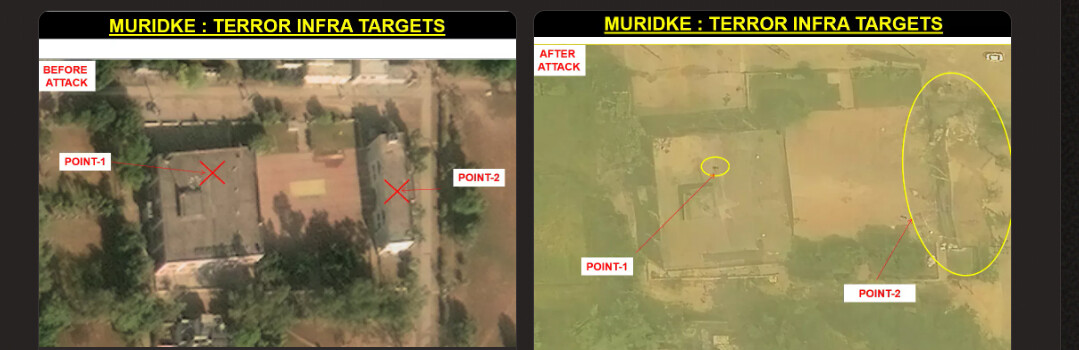
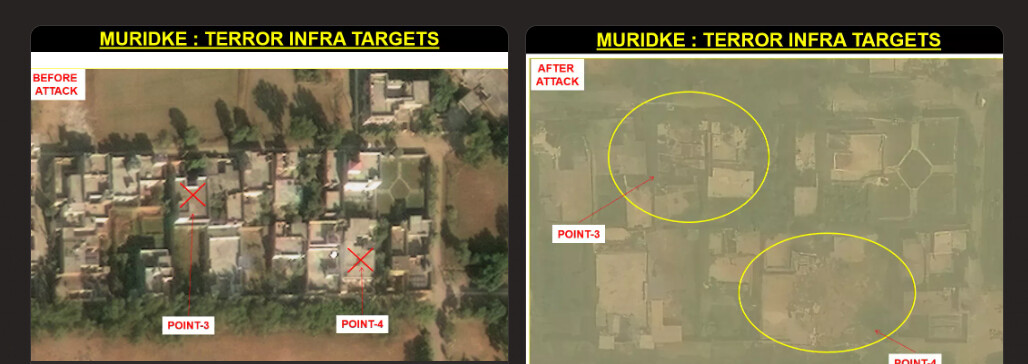
Pakistan called them mosques. Pakistanis with phones disagreed. Sky News in London geolocated videos filmed inside the Muridke compound and posted to TikTok, YouTube and Google. They show Lashkar-e-Taiba and “Brigade 313” flags, and in one clip children do martial-arts drills under a jihad hashtag. The congregation also identified itself. Jaish chief Masood Azhar publicly mourned ten relatives and four associates killed at Bahawalpur, which is a lot of deaths for a building that wasn’t hit. India’s government says more than a hundred militants died across the nine sites. One of them was Abdul Rauf Azhar, the man behind the IC-814 hijacking and the murder of Daniel Pearl.
A compound that trains armed men and flies a militant flag doesn’t become a house of worship because someone stands in the rubble afterwards and calls it one. India hit the headquarters of the groups behind Mumbai and Pulwama, and the “mosque” kept holding funerals for fighters.
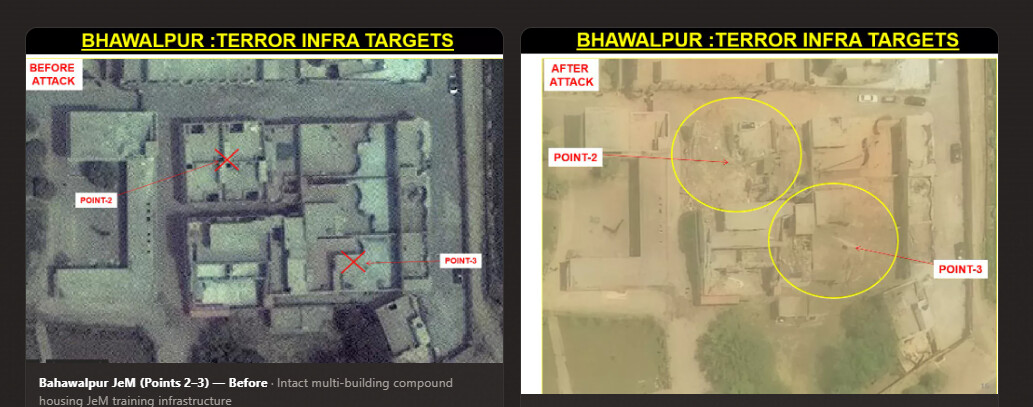
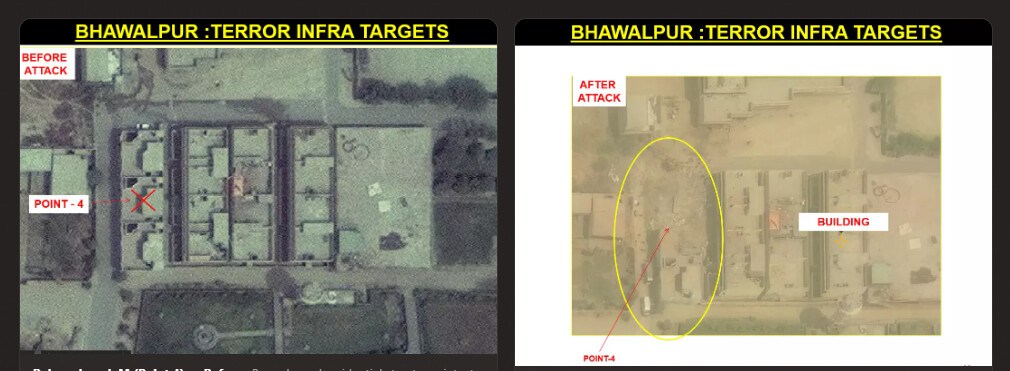
Bahawalpur, building by building
Markaz Subhan Allah got less international airtime than Muridke, but its record is more detailed: four separate aim points, each confirmed on its own.
The other seven
Muridke and Bahawalpur got the coverage. The other seven rarely do, so here is the full first-wave list. Pakistan disputes two of them, and they’re marked.
| # | Facility | Location | Coordinates | Status |
|---|---|---|---|---|
| 1 | Markaz Taiba (LeT HQ) | Nangal Sahdan, Muridke | 31°50′10″N 74°15′47″E | Struck; imagery above |
| 2 | Markaz Subhan Allah (JeM HQ) | Bahawalpur, Punjab | 29°23′44″N 71°41′01″E | Struck; imagery above |
| 3 | Tehra Kalan training camp | Sialkot, Punjab | 32°29′24″N 74°25′12″E | Struck |
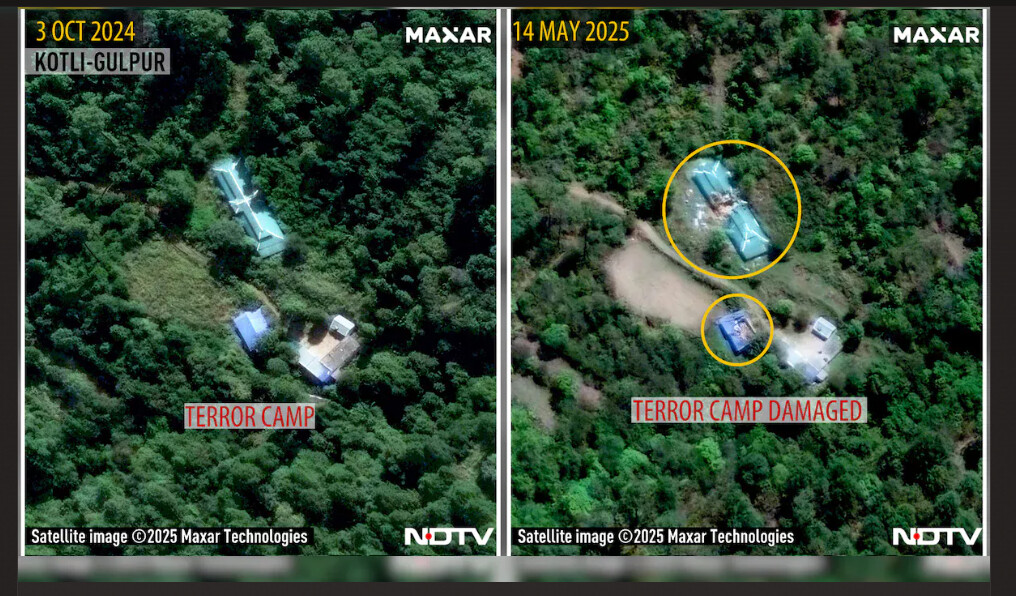
| 4 | Gulpur camp (Maskar Raheel Shahid) | Kotli district, PoJK | 33°26′05″N 73°51′40″E | Struck. Pakistan disputes it; dated Maxar imagery below says otherwise |
| 5 | Masjid-e-Abbas (JeM) | Kotli, PoJK | 33°31′06″N 73°54′08″E | Struck |
| 6 | Mehmoona Joya facility (Hizbul Mujahideen) | Sialkot, Punjab | 32°30′00″N 74°31′48″E | Struck |
| 7 | Markaz Usman-o-Ali (Barnala/Ahle Hadith) | Bhimber, PoJK | 32°58′29″N 74°04′23″E | Struck. Pakistan disputes this one |
| 8 | Shawai Nala camp (LeT) and Masjid Syedna Bilal (JeM) | Muzaffarabad, PoJK | 34°21′48″N 73°28′05″E | Struck: two facilities, one strike |
| 9 | Training camp | Neelum Valley, PoJK | 34°35′00″N 73°55′00″E | Struck |
Rows 4 and 7, Gulpur and Barnala, are the two sites the government has repeatedly denied were struck. The satellite record on Gulpur, below, disagrees.
Act II The air-defence network, now available as gravel
Pakistan answered with numbers. On the night of 7-8 May it sent drones and missiles at fifteen Indian locations: Awantipura, Srinagar, Jammu, Pathankot, Amritsar, Kapurthala, Jalandhar, Ludhiana, Adampur, Bathinda, Chandigarh, Nal, Phalodi, Uttarlai and Bhuj. Over the following nights that came to something like 600 drones and 800 munitions. They flew into an Indian air-defence net made up of the Akashteer system feeding the IACCS, the indigenous Akash, the Israeli SPYDER, and the S-400 held in reserve. According to the military historian Tom Cooper, in his study 88-Hours War, it shot them down at a rate close to 100 percent.
Pakistan also reached for its best weapons. It fired the CM-400AKG, a “carrier-killer” it had bought to sink Indian aircraft carriers, at parked radar dishes. It fired the nuclear-capable Ra’ad cruise missile too, and India reports catching several of those in the air. None of it changed the arithmetic. The Chinese-built shield over Pakistan worked well right up until it was asked to defend something.
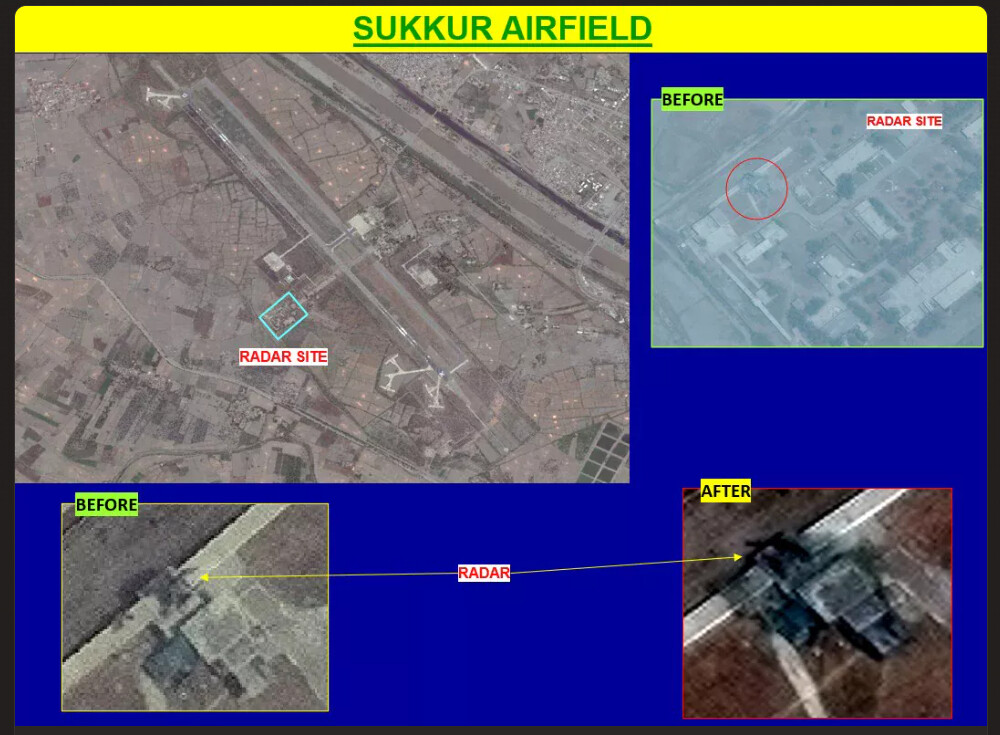
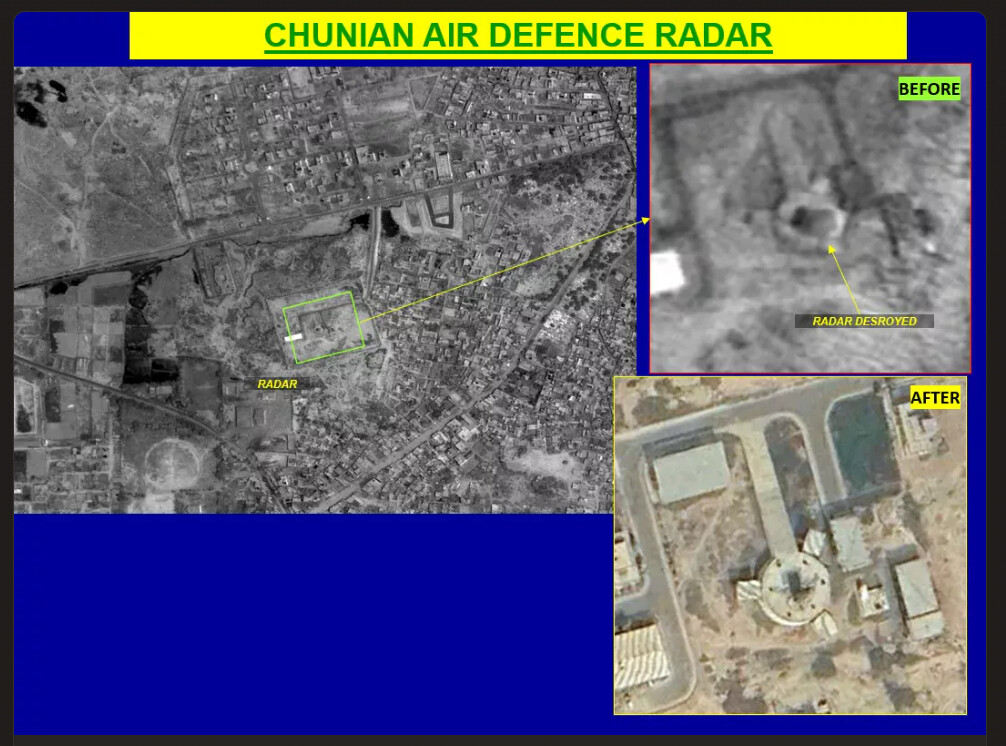
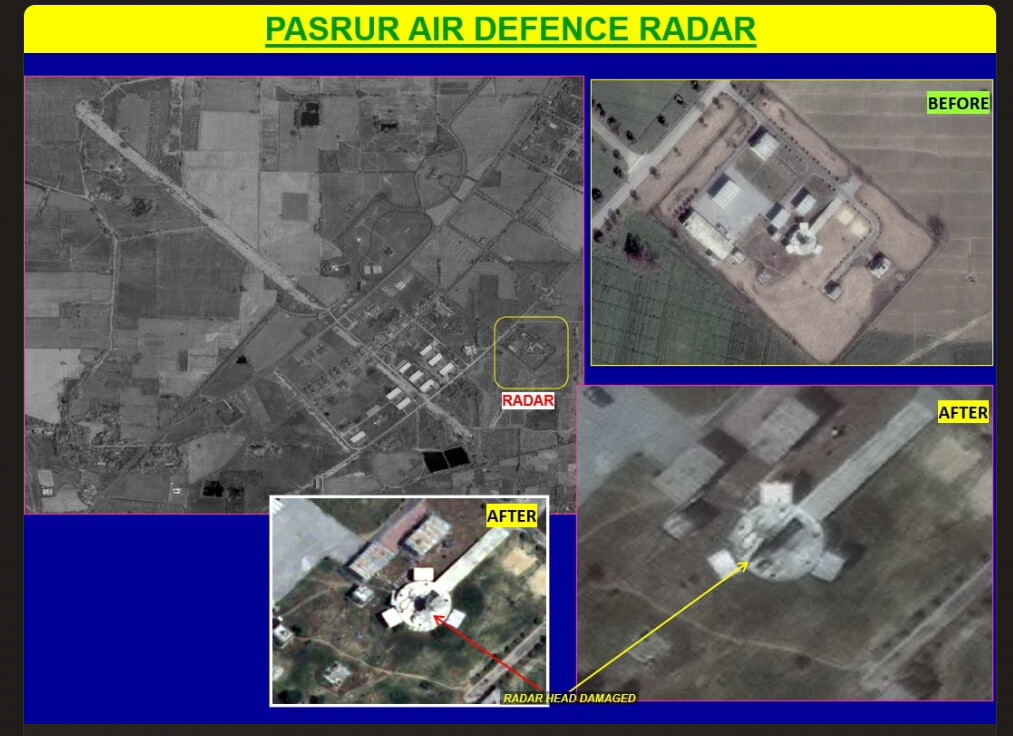
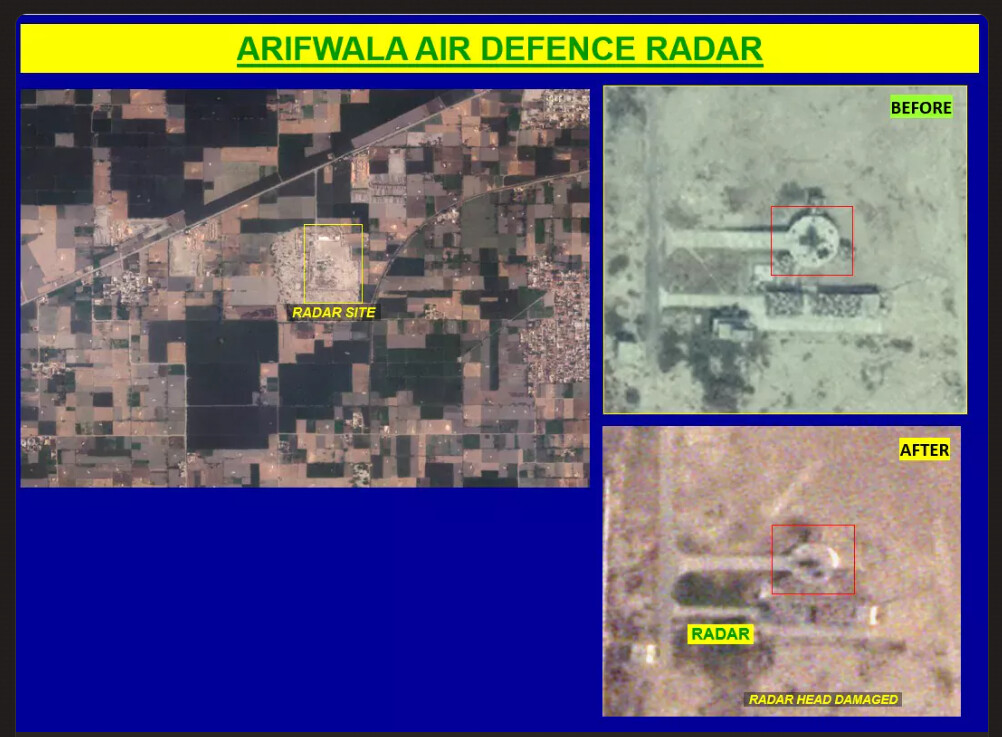
Then it really did turn into gravel. Across 7 and 8 May, Indian Harop and Harpy loitering munitions, backed by jamming that blinded the radars, went after the HQ-9 batteries around Lahore and Sialkot. Before-and-after imagery confirms six radar heads destroyed, at Chunian, Pasrur, Sukkur, Arifwala, Jacobabad and Gujranwala. Each shows the sequence satellite analysts know well: dish present, dish gone, men standing around the spot where the dish used to be.
Cooper’s day-by-day reconstruction isn’t kind to Pakistan. On the evening of 7 May it emptied its magazines, firing three to four hundred drones and Fateh-1 rockets at some thirty locations, for next to no effect. India’s reply the next morning was roughly 160 Harop loitering munitions into three HQ-9 batteries. Cooper judges the Walton battery inside Lahore “largely destroyed”, and the munitions reached as far as the army’s own headquarters district in Rawalpindi. He also spots the flaw in Pakistan’s plan: it had two or three days’ worth of drones and rockets and no money to buy more. India could keep going for as long as it liked.
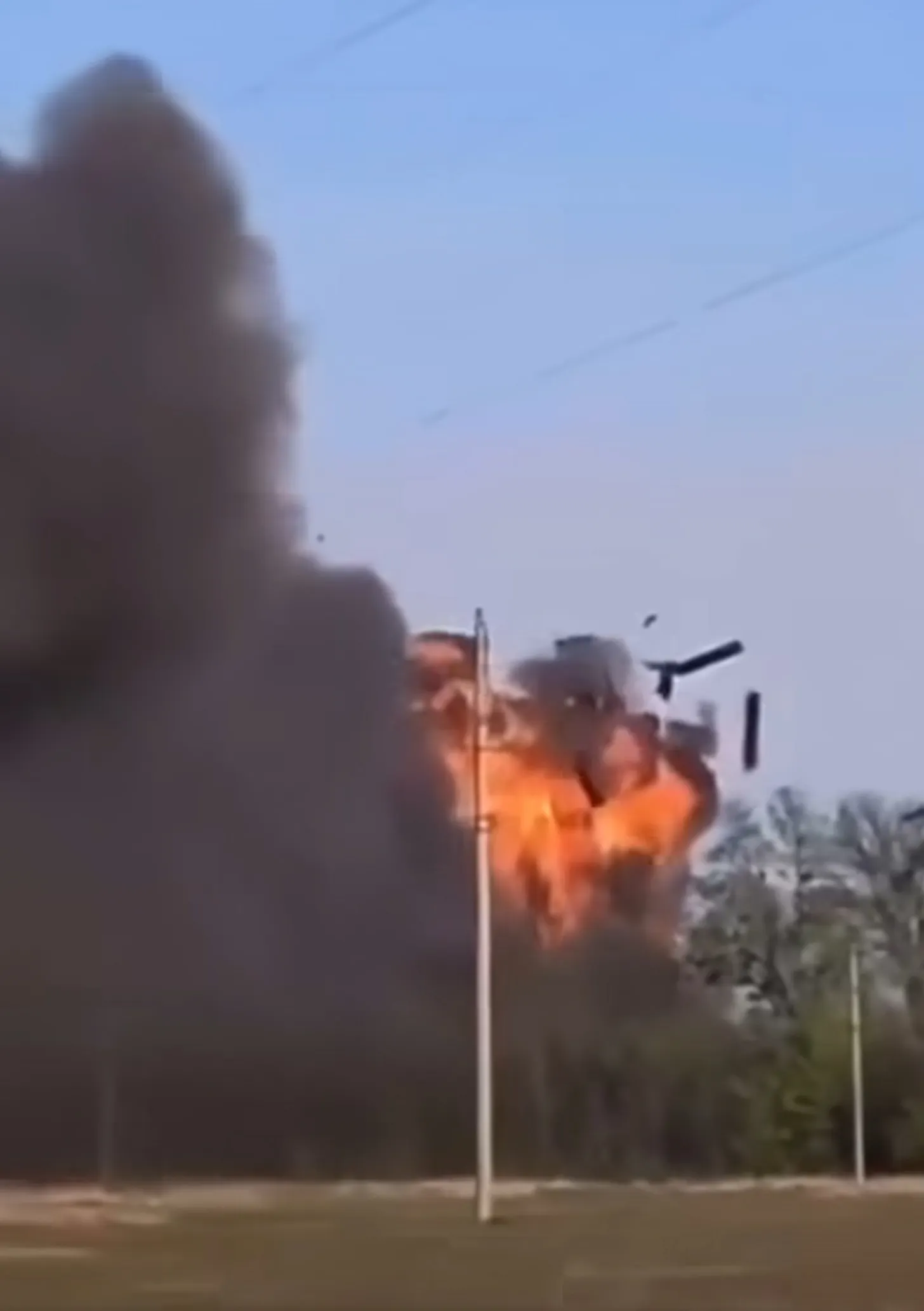
One Harop was filmed taking apart a Swiss-made Oerlikon gun. Ground photographs show Pakistani soldiers posing next to their own burnt-out HQ-16 surface-to-air system, and other footage caught a Pakistani SAM battery being towed through the streets of Lahore to keep it safe, which is an odd look for a weapon whose whole job is to stay put and fight. By the night of the ninth the shield had holes in it, and India had a map of every one.
None of this was improvised. Months later the Indian Air Force chief, Air Chief Marshal AP Singh, gave a memorial lecture in Bengaluru and went through the targeting base by base, on the record, with before-and-after frames. A briefing slide that matches the lecture lays out the order: a 02:00 to 05:00 window on 10 May against Chaklala, Rahwali, Rafiqui, Rahim Yar Khan, Sukkur, Murid and Nayachor, then a 10:00 to 12:00 window against Sargodha, Bholari and Jacobabad. Each target is tagged with what was hit: SAM, runway, hangar, or “UG C2”, which is the underground command bunker you’re not supposed to know Pakistan has.
02:00-05:00Before dawn: seven airfields
- Nur KhanChaklala33.62°N 73.10°EUG C2
- MuridChakwal32.91°N 72.77°EUG C2
- Rahim Yar Khan28.38°N 70.28°ERWY
- RafiquiShorkot30.76°N 72.28°ERWY UAV
- Sukkur27.72°N 68.79°ERADAR
- Rahwali32.29°N 74.14°EAFLD
- Nayachor25.75°N 69.77°EAFLD
10:00-12:00The second wave: three airfields
- SargodhaMushaf32.05°N 72.67°ERWY
- Bholari25.24°N 68.04°EHGR
- JacobabadShahbaz28.28°N 68.45°EHGR RADAR
The slide is also the clearest confirmation that the target at Murid was an underground command-and-control bunker, a hardened complex next to the base’s drone hangars, marked as a direct hit. Once your buried bunker turns up, correctly labelled, in the other side’s PowerPoint, it isn’t much of a secret any more.
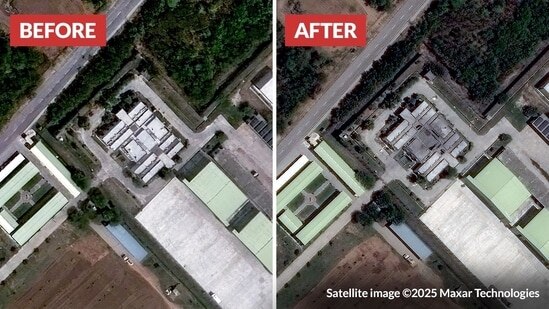
A longer list, with caveats
A wider tally of Pakistani radar and SAM sites has been going around: thirteen entries, with named equipment and grid coordinates. The exact model identifications and arc-second coordinates go further than I can independently confirm. Where a row matches the imagery above, it’s solid. Where it doesn’t, treat it as a rumour.
| Site | System (as reported) | Coordinates | Status (as reported) |
|---|---|---|---|
| Arifwala radar site | AN/TPS-77 or YLC-8B | 30°07′36″N 72°59′26″E | Struck and destroyed; matches the imagery above |
| Chunian radar site | AN/TPS-77 or YLC-8B | 30°57′25″N 73°58′12″E | Struck and destroyed; matches the finding above |
| Pasrur radar site | AN/TPS-77 | 32°14′19″N 74°41′21″E | Struck and destroyed; matches the imagery above |
| Sukkur radar site | AN/TPS-43G/J | 27°43′00″N 68°47′20″E | Matches the confirmed Sukkur radar strike above |
| Sargodha radar site | AN/TPS-77 | 32°03′20″N 72°40′05″E | Reported, near PAF Mushaf, Sargodha |
| Jacobabad, second radar site | Giraffe 40 (mobile) | 28°17′08″N 68°27′42″E | Reported struck and destroyed, separate from the Shahbaz radar below |
| Shahbaz (Jacobabad) radar site | AN/TPS-77 (radome) | 28°16′15″N 68°28′00″E | Reported struck, near PAF Shahbaz |
| Bholari radar site | Likely AN/TPS-77 | 25°14′49″N 68°01′02″E | Reported struck, near PAF Bholari |
| Murid SAM site | Likely FM-90 | 32°55′09″N 72°45′54″E | Consistent with the underground-complex strike confirmed above |
| Nur Khan SAM site | HQ-9BE | 33°37′16″N 73°05′03″E | Reported ineffective against the Indian strike |
| Malir Cantonment SAM site | HQ-9BE | 24°56′11″N 67°12′37″E | Matches the confirmed strike from the sea; see below |
| Walton Airport SAM site | HQ-9P/BE | 31°31′N 74°24′E | Reported: C2 vehicle destroyed |
| Chor radar site | AN/TPS-77 (reported under construction) | 25°31′32″N 69°46′27″E | Unconfirmed. Reported only as “possibly targeted” |
Six of these thirteen rows back up findings already established through named imagery or on-record statements. The rest come from a wider compilation I can’t verify independently. They’re here for completeness, not as settled fact.
Act III Eleven air bases that are completely fine
Then came the blitz, in two rounds. The Observer Research Foundation counts four air bases confirmed damaged on 9 May and four more with limited damage on the 10th. The heavy strikes landed between 02:00 and 05:00 that morning, when India’s air force visited the Pakistan Air Force where it lives. Eleven air bases are confirmed by name, and Sukkur and Skardu, which are harder to confirm from imagery, bring the map to thirteen. Roughly a fifth of PAF infrastructure was destroyed in that three-hour window alone. A Swiss think tank later concluded that the IAF had won air superiority and pushed Pakistan to the ceasefire table. Runways and hangars are about the hardest things there are to hide afterwards. You can’t say a runway is fine while it has a crater in it, and you can’t frown a hangar off a satellite image, though the Ministry has tried. Here is what the satellites keep finding, base by base.
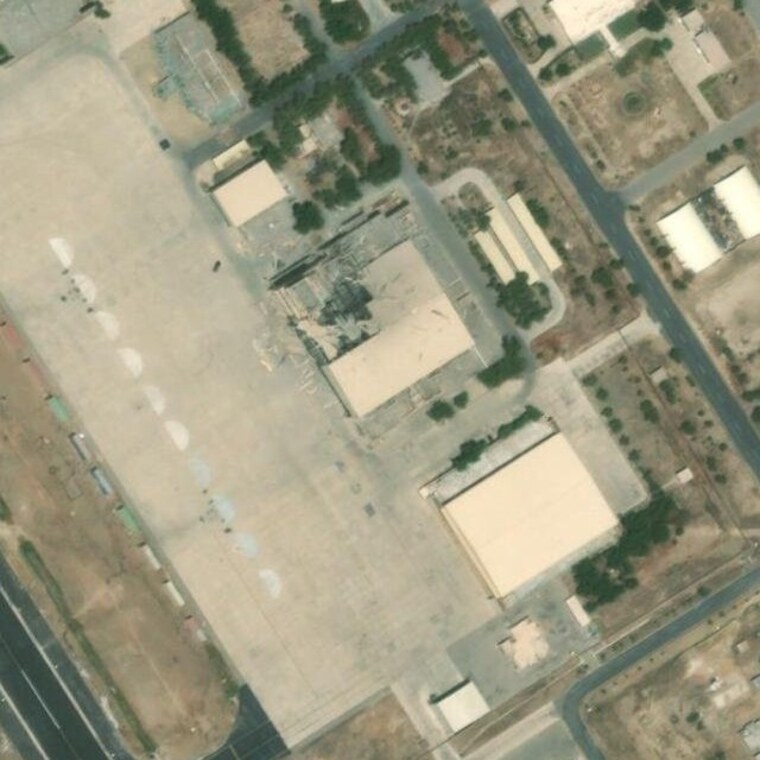
Jacobabad: the hangar that opened
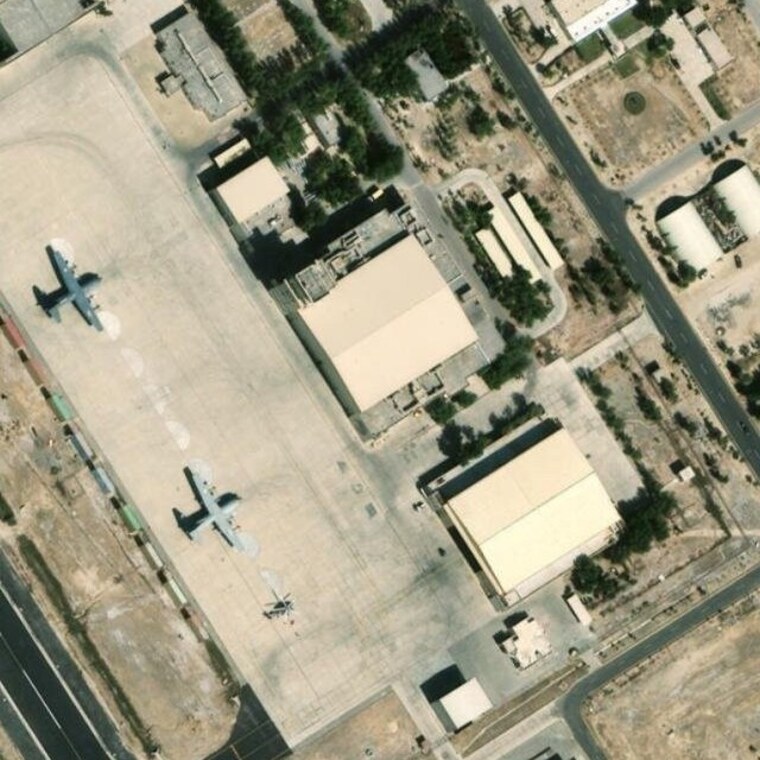
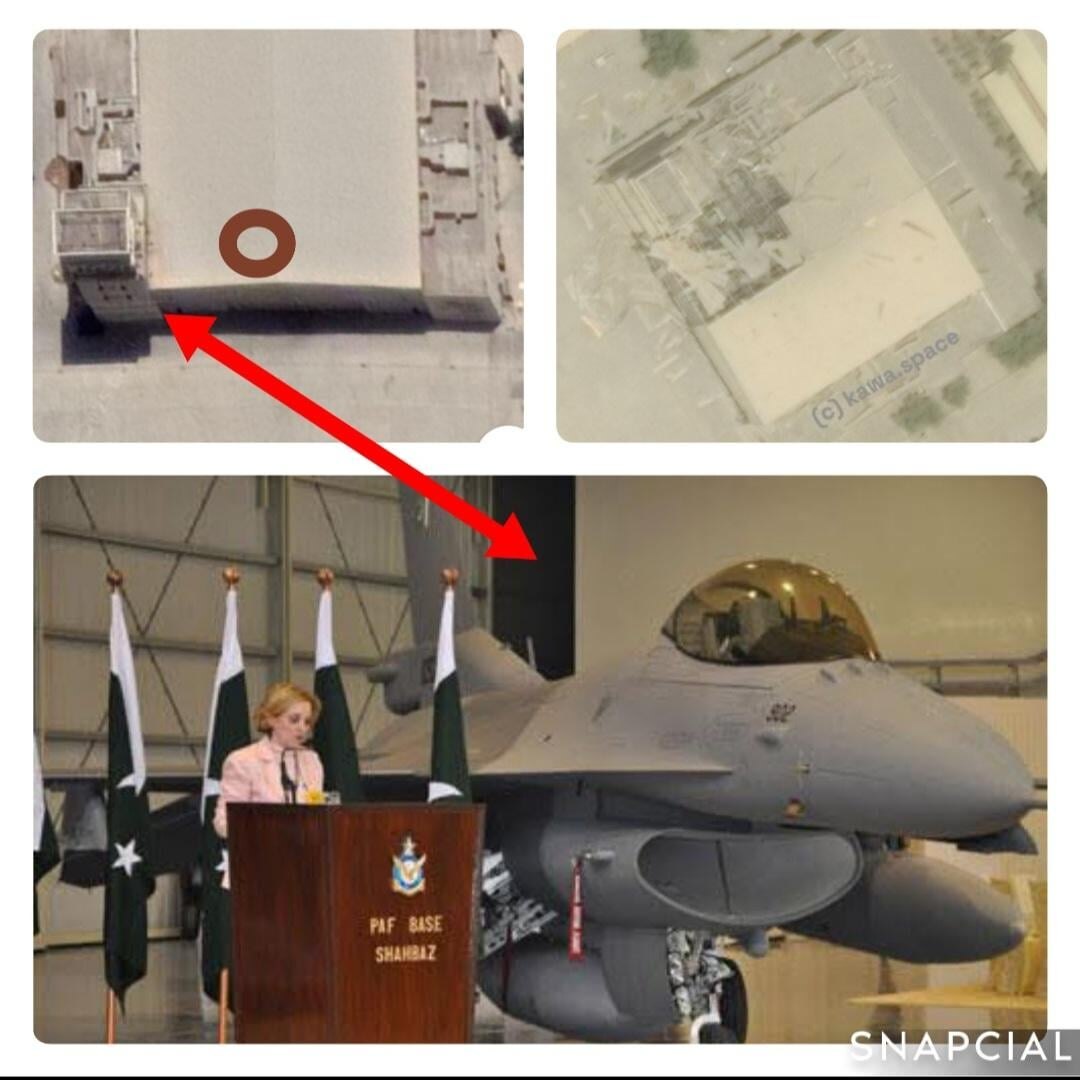
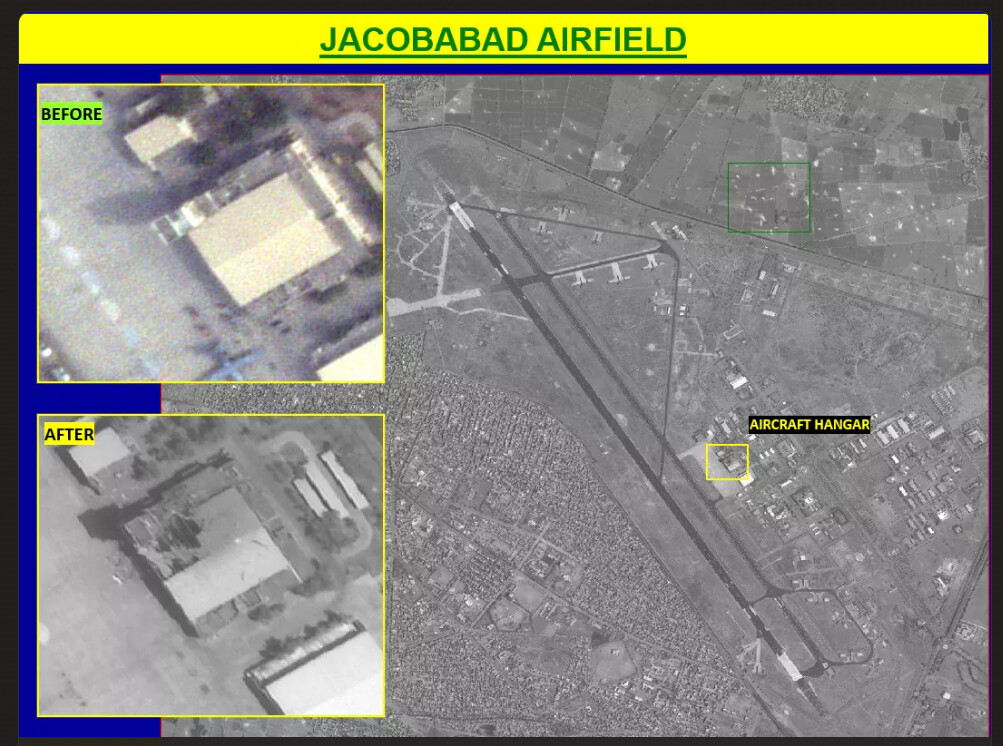
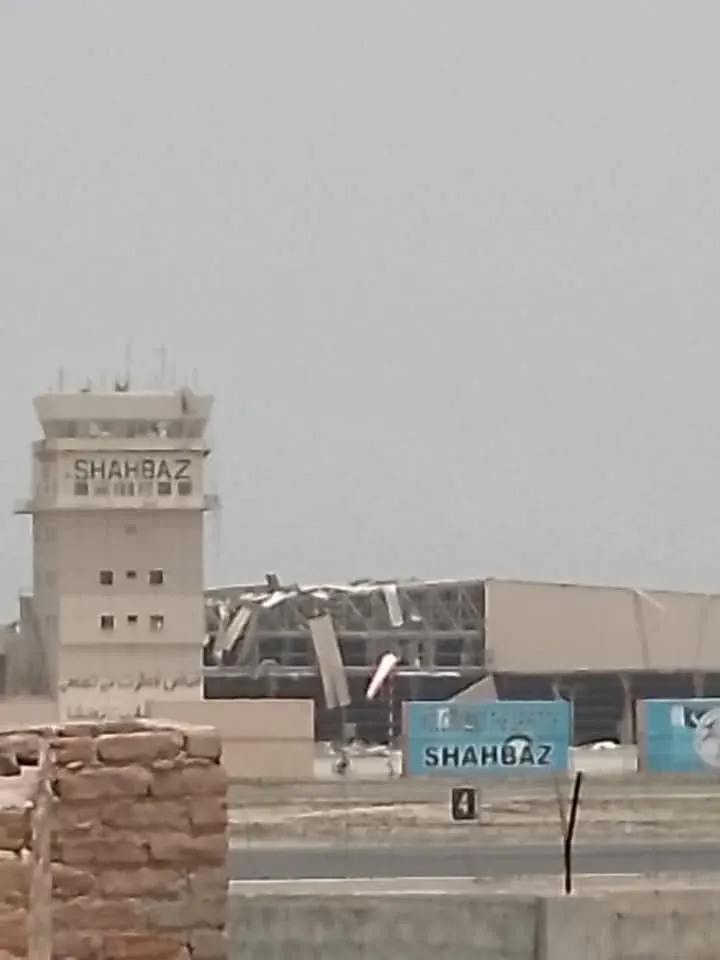
This is the clearest single frame of the whole war. Zoom in on the apron at Jacobabad: an intact hangar in 2024, its roof blown open in 2025, and the aircraft that used to be parked outside now somewhere else.
 AUG 2024
SEP 2025
HANGAR ROOF
PAF BASE SHAHBAZ, 28.28°N 68.45°E
AUG 2024
SEP 2025
HANGAR ROOF
PAF BASE SHAHBAZ, 28.28°N 68.45°E
Nur Khan: next door to army headquarters
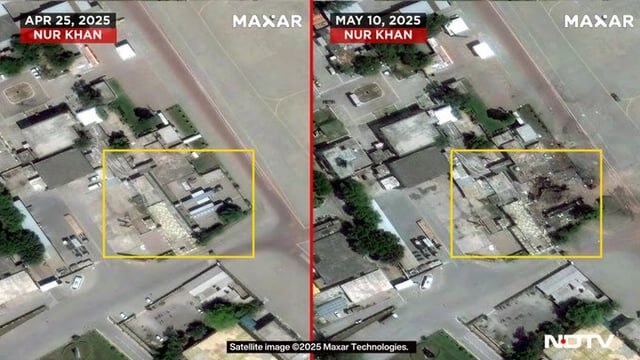
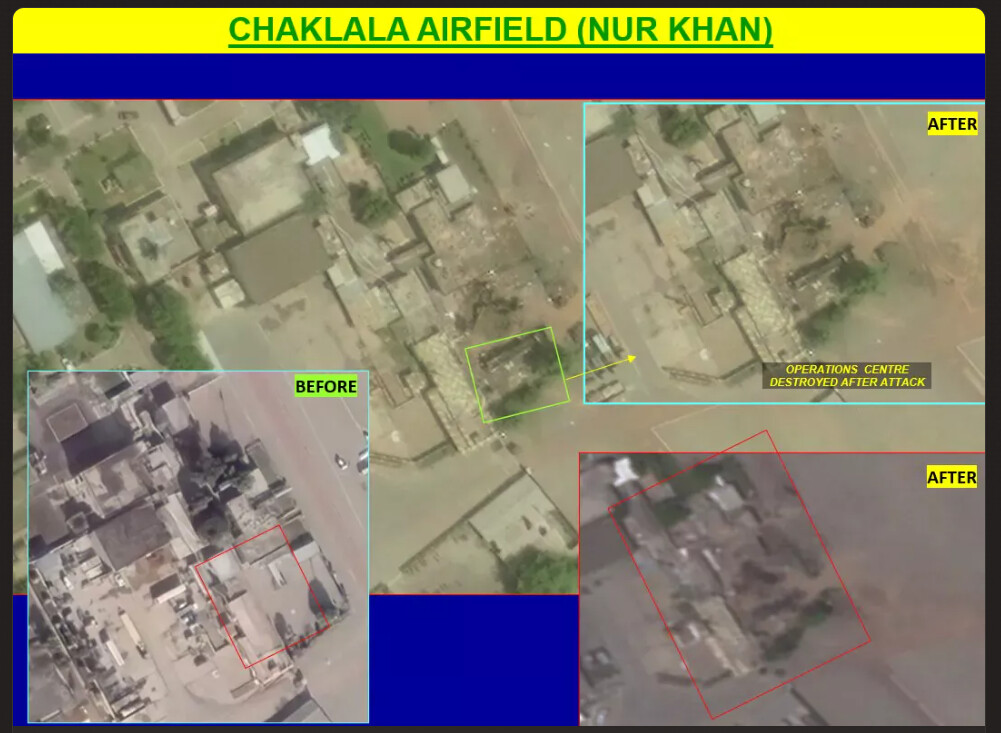
Hitting Nur Khan was the boldest single move of the operation. A precision weapon went into a base minutes from the centre of the Pakistani military, and the message about reach was hard to miss. Cooper’s reconstruction adds another loss on the same apron: a C-130 Hercules transport, set on fire.
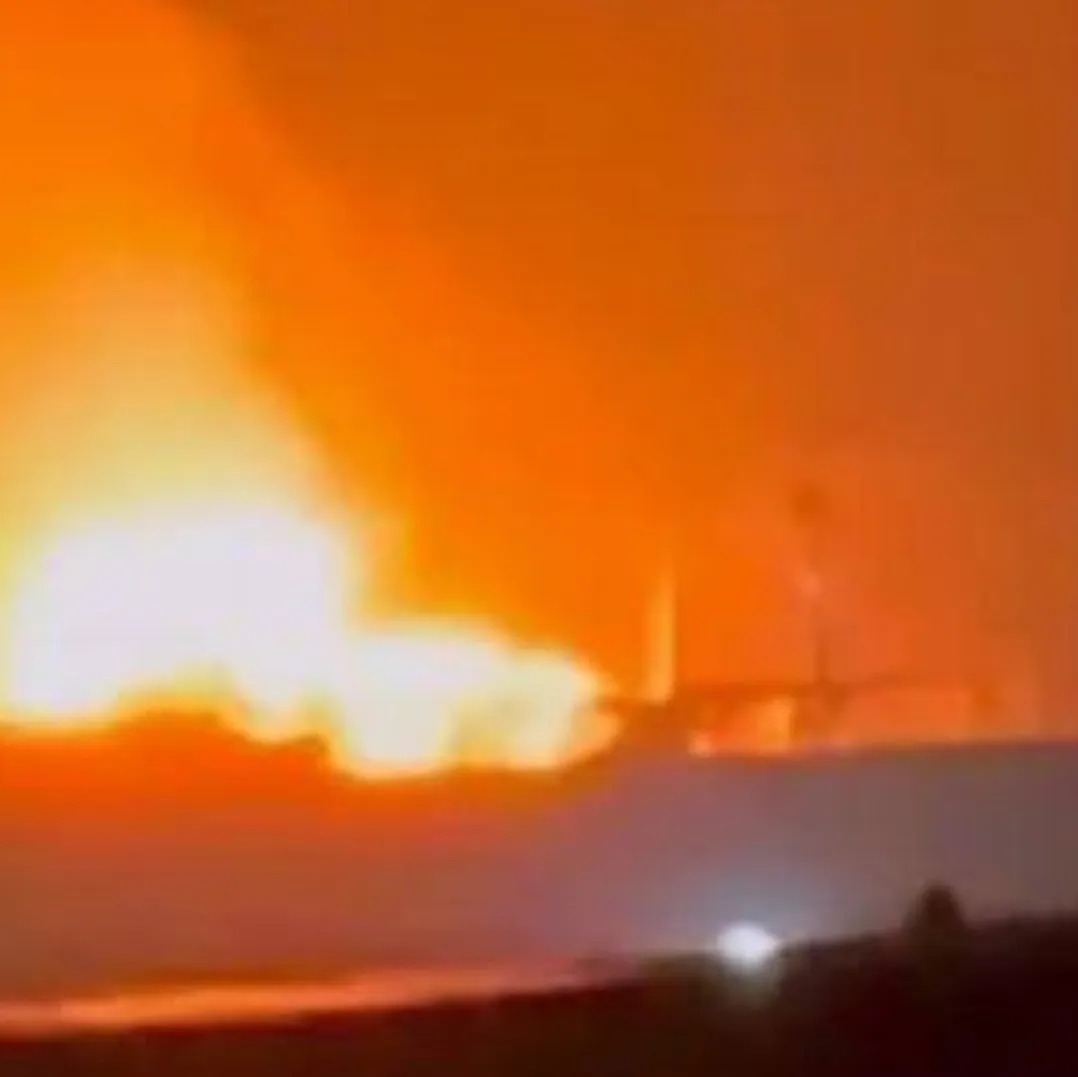
Bholari: a hangar, a $300 million aircraft and a name
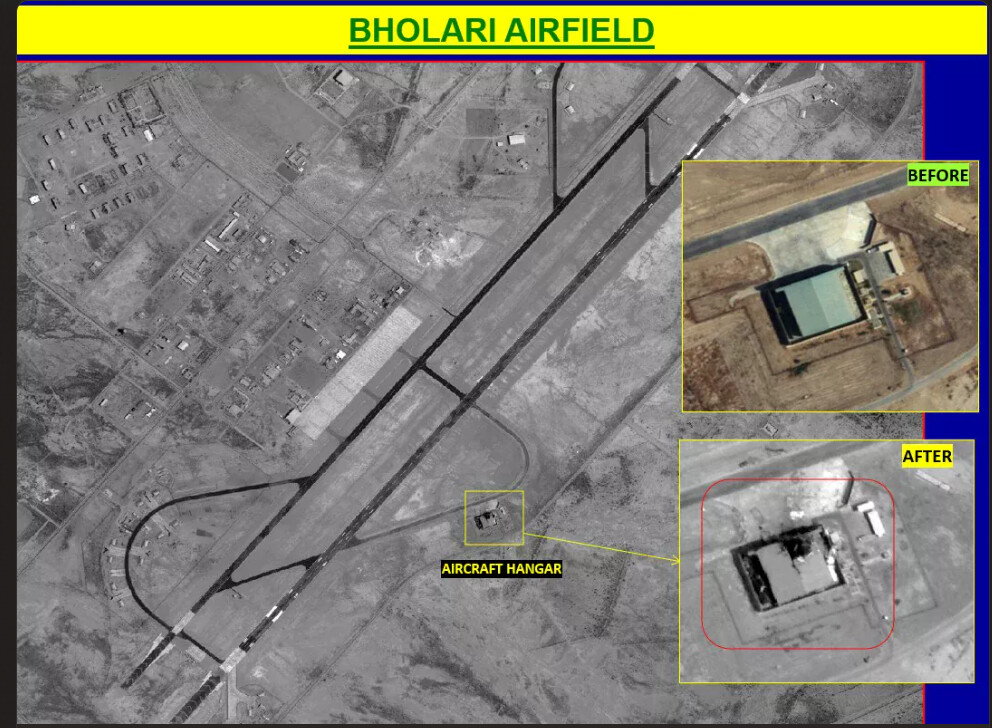
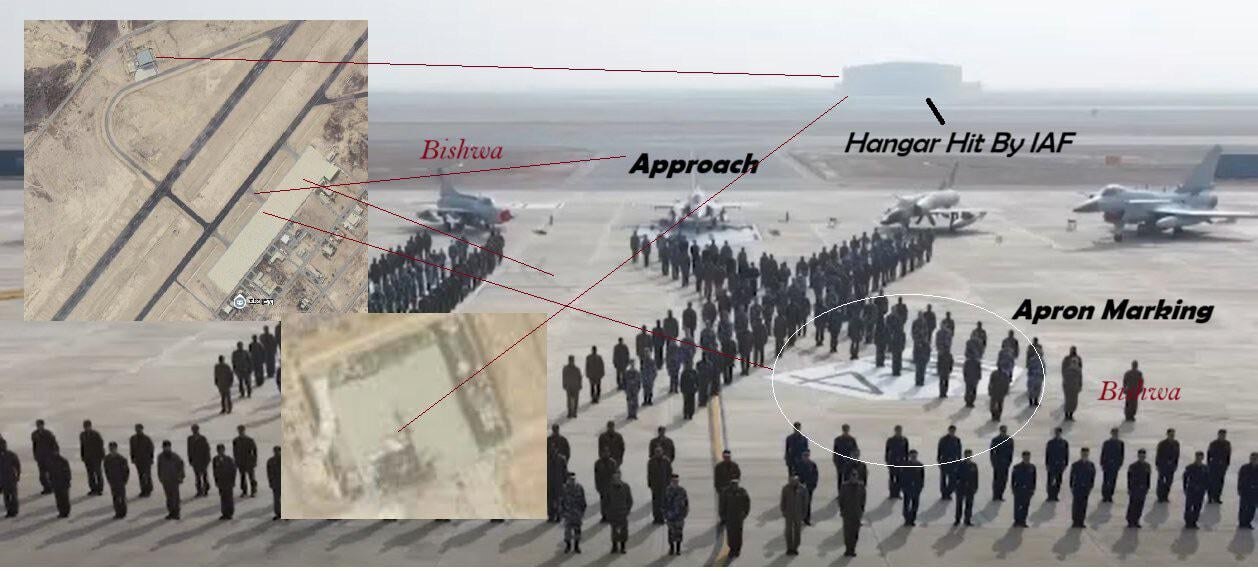
Bholari is also where the denials run out, and where I stop joking. Pakistan’s own military conceded that five airmen were killed here, and Pakistani sources named one of them: Squadron Leader Usman Yusuf. A state doesn’t concede dead men by base, number, rank and name at a place it says was never touched. If anything at Bholari is absurd, it’s the officials who still tell his countrymen it didn’t happen.
Sargodha: craters on the master jet base
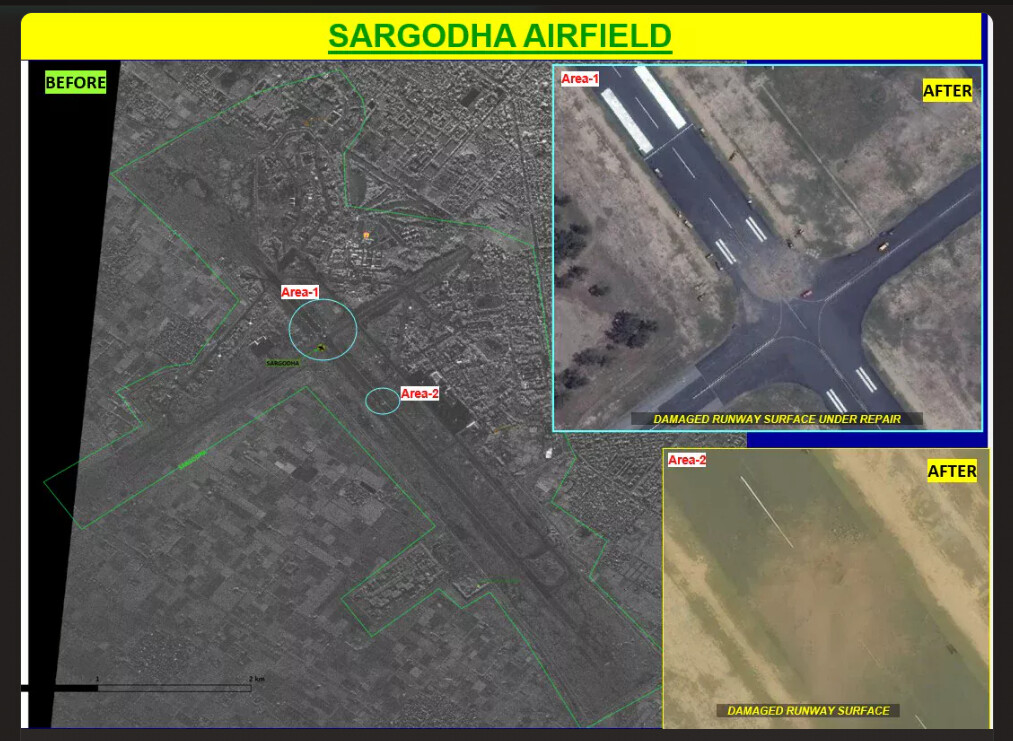
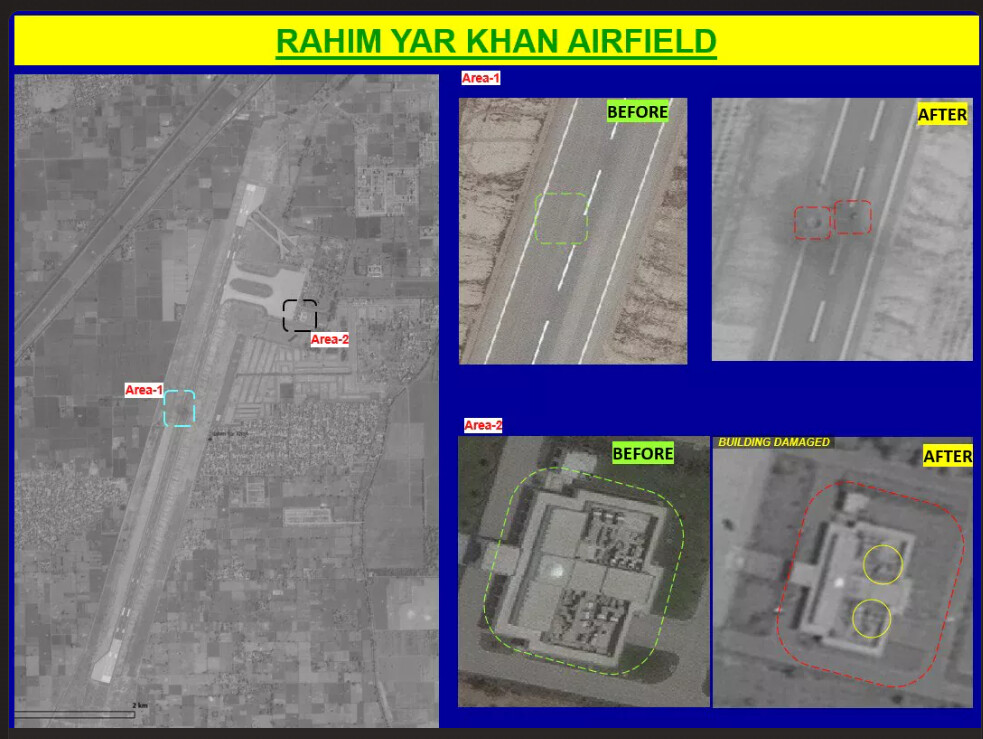
Beyond those four, India also hit Rahim Yar Khan (runway cratered, field closed). A footnoted monograph from the Centre for Air Power Studies (CAPS) names all eleven bases and adds Rafiqui (runway and drone-control complex), Sialkot, and Murid, where the target was another underground bunker next to a hangar full of Turkish and Pakistani drones. Masroor on the Karachi coast and two bases that barely make the English-language news, Rahwali and Nayachor, complete the eleven. At Skardu the CAPS study admits it can’t confirm the exact target because there’s no imagery, which is more honesty than Pakistan’s information ministry managed all year. India says it downed as many as thirteen Pakistani aircraft across the operation. For a while that was only New Delhi’s word, but the air-to-air picture has since cleared, and it cleared in India’s direction, largely through footage Pakistanis filmed themselves (see below). Pakistan claimed six Indian jets and produced wreckage from none of them.
The navy’s plan: stay where the boats were
While the air force scrambled, the navy stuck to a doctrine strategists might call staying exactly where the boats were. India had moved its Western Fleet (a carrier, destroyers, frigates and anti-submarine ships) into the northern Arabian Sea, within strike range of Karachi. Its Director-General of Naval Operations said the fleet was in position to hit the city “at a time and place of our choosing”. You say that when you’ve already checked and nobody is coming out. The Pakistan Navy studied the threat and answered with the one manoeuvre it had practised to perfection: mooring.
It wasn’t a bluff. Air Marshal AK Bharti confirmed on the record that a missile site at Malir Cantonment, an army garrison inside Karachi, had been struck, and a Pakistani journalist added that it “was carried out from the sea, using the warship INS Vikrant”. So the air force and the navy reached the same city from two directions, and once again it was a Pakistani commentator who confirmed it.
You could call a fleet that sits at anchor for four days within reach of an enemy carrier “preserving its strength”. You could also call it hiding. Either way, a fleet that never sails can’t be sunk, and the Pakistan Navy kept that record intact from the pier.
What fell out of the sky
For weeks the air-to-air score was the murkiest part of the war. Both sides claimed kills and neither showed the wreckage. When that fog lifted, it lifted the wrong way for Islamabad. The footage that surfaced after May 2025, geolocated and cross-checked frame by frame, shows Pakistani aircraft coming down over Pakistani soil, including the two things an air force can least afford to lose: its flying radar and its pilots.
The Erieye over Dinga
The most valuable aircraft Pakistan has isn’t a fighter. It’s the Saab 2000 Erieye, the flying radar that tells every other jet where the enemy is. On 10 May one was tracked and destroyed in the air over Dinga by an Indian S-400 firing its 40N6E interceptor, the 400-kilometre missile. It was that missile’s first combat use anywhere, and the kill is credited as one of the longest-range air kills on record. Circulated video caught the interception and the fireball. Other clips caught debris falling toward Gujranwala, and residents who took the two tumbling halves of the aircraft for two falling jets. For once, Pakistan chose not to adopt the bigger number.
Pakistan can’t absorb this loss. It flies only a handful of Erieye aircraft, and India had already burned one on the ground at Bholari. Take a second one out of the sky (a third, if Kohat holds up) and you’ve blinded every fighter that relied on them. An air force without its eyes is feeling its way around a dark room while announcing on national television that it can see perfectly, and then walking into the furniture.
A JF-17 over Dinga
Fighters came down too. Over the same fields at Dinga, a JF-17, the Sino-Pakistani mainstay of the fleet, hit the ground. The debris included the scorched exhaust nozzle of its Russian RD-93 engine and a blackened avionics box, which a villager carried off. He now owns more of a JF-17 than he expected to this year.
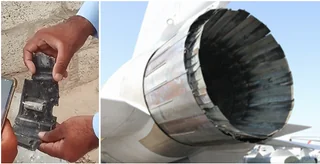
Then came the PAF’s finest piece of accounting. Instead of admitting it lost a jet at Dinga, it held a press conference to announce that it had “intercepted a missile”, and showed off the wreckage of a 40N6E as a trophy. That’s the long-range interceptor built to kill aircraft, and it doesn’t fall on open farmland unless it has just been fired at something in the sky. What came down at Dinga burned in a fireball far too big for the “drone” that local police first reported. If India had really lost a drone there, Islamabad would have paraded it from one end of the country to the other instead of waving a spent missile casing. Showing off the interceptor that just shot you down, as proof you won, is like getting mugged and holding up the mugger’s business card to show you came out ahead.
The Mirage argument
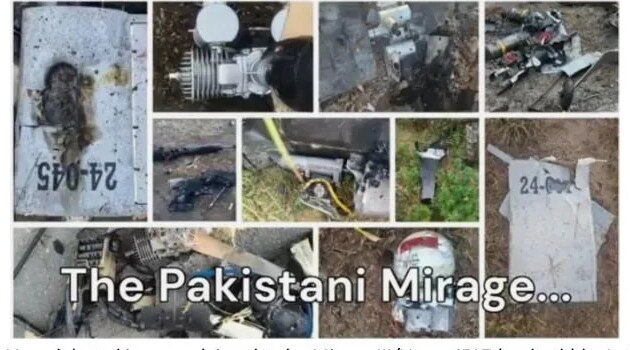
Then there’s the Mirage. A field of wreckage, including a wing panel stencilled 24-045, a shattered engine and an ejection seat, went round the internet with competing captions. Indian accounts called it a downed PAF Mirage III/V. Pakistani accounts said, with the confidence of a losing hand, that it was an Indian Mirage 2000, or maybe a MiG-29, and the story changed by the hour. The argument lasted exactly as long as it took someone to look at the engine.

The neatest confirmation came from the most restrained source available. When India’s Directors-General of Military Operations held their formal briefing, the one that took pains to say the fight was “with terrorists, not the Pakistani military”, the first exhibit on screen was video of the debris of a downed Pakistani Mirage. India spent that press conference playing down what it had hit and still opened with a Pakistani fighter in pieces on the ground. When even the polite version of events starts with your jet in a field, the argument is over.
The counter nobody told to stop
The funniest piece of evidence in the whole war belongs to neither government. Martin-Baker, the British firm that builds most of the world’s ejection seats, keeps a public “lives saved” counter on its website. It goes up by one every time a pilot pulls the handle and lives. It’s a nice bit of engineering pride, and, unluckily for Rawalpindi, a tamper-proof count of how many aircrew had to abandon an aircraft.
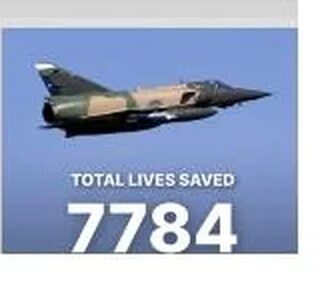
Here’s why that matters. Martin-Baker only logs successful ejections, where a pilot leaves a doomed aircraft and survives, and under standard confidentiality agreements with air forces it withholds the where, the when and the what for any loss in active combat. Across the 88 hours, the counter moved by several ticks with the details left blank. Which aircraft in this fight sit their pilots on Martin-Baker seats? Pakistan’s F-16s, JF-17s and Mirage III/Vs, for a start. The blank ticks line up with Pakistani pilots getting out of aircraft that Islamabad insists it never lost. Pakistan’s government issued denial after denial, while an ejection-seat maker in Buckinghamshire, updating a web page, kept the receipts.
Pilots in the fields
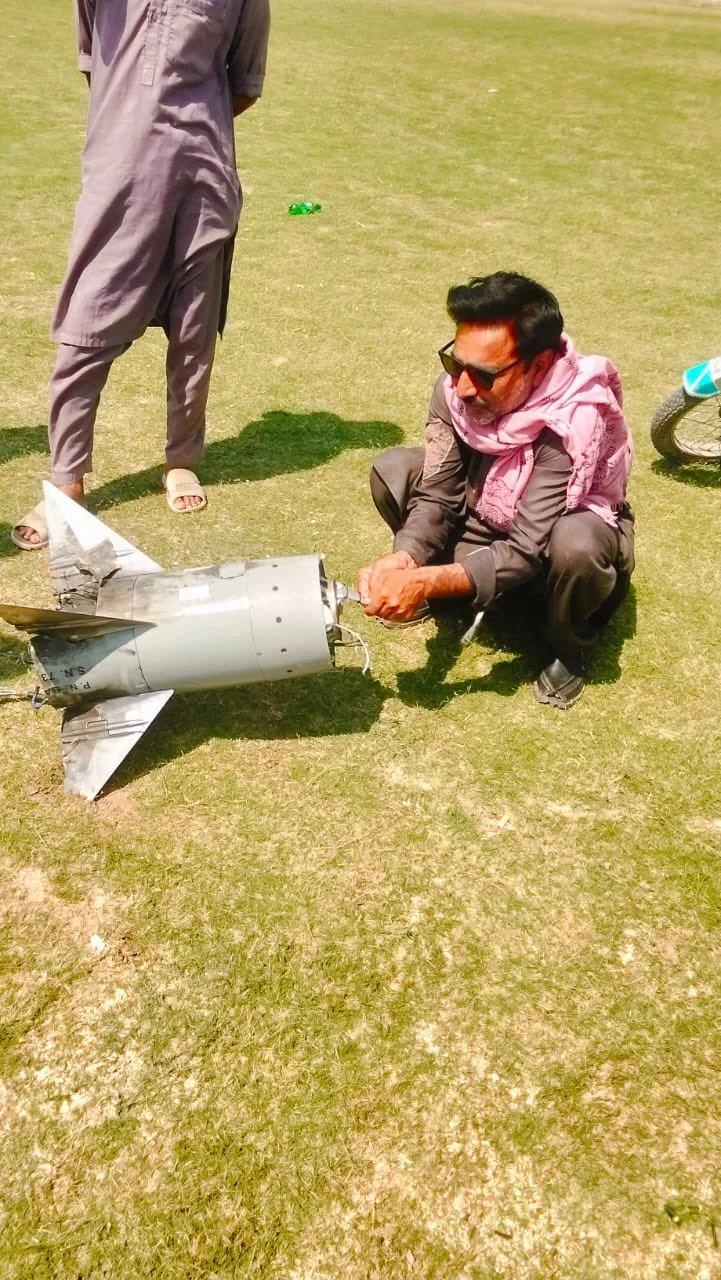
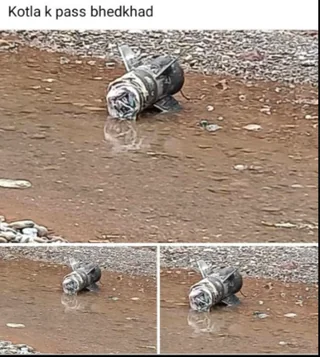
Then there were the crews. In the days around 10 May, video after video showed Pakistani villagers combing fields and canals for their own downed airmen: a pilot filmed parachuting down and then searched for on the ground, another confronted by villagers in Sialkot after being found at night, and civilians in Bhimber hunting for aircrew near where a missile booster had come down. In the same Sialkot fields the booster of an Indian MR-SAM (Barak-8) interceptor turned up with its serial number still legible, which shows how hard, and how close to Pakistan’s own towns, the air battle was fought.
The home videos
None of this came with an official press release. It’s footage Pakistanis filmed themselves, the fireballs, the debris and the searches, and posted before anyone in uniform could suggest they hadn’t seen anything. Every clip plays.
 Booster debris, Kotla
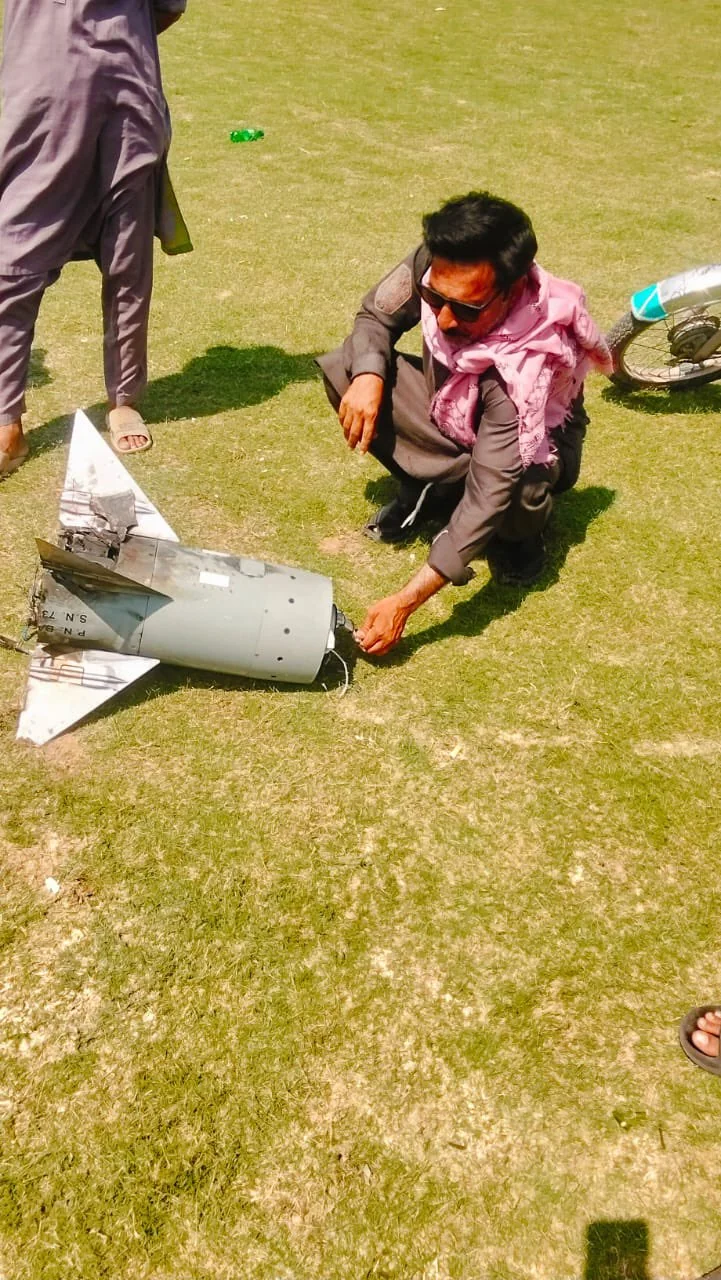 MR-SAM booster, second view
By the last day, according to Cooper, the PAF was stretched so thin that it pushed its K-8 Karakorum jet trainers into the fight. These are the aircraft of its own “Sherdils” aerobatic display team. It bolted 23-millimetre gun pods underneath and sent them up on combat patrols to swat Indian loitering munitions, with what Cooper drily calls “unknown success”. Picture it: the airshow squadron, the one that draws smoke trails in the national colours, handed live gun pods and scrambled to chase robots out of the Punjab sky. An air force that had won the war doesn’t end it flying its display team at drones, watching its own citizens film the wreckage and searching its own fields for its own pilots. Cooper’s verdict is that India called the nuclear bluff, gutted Pakistan’s ability to retaliate and pushed the PAF back from the border, and that by the ceasefire the balance between the two states had changed for good. You don’t have to take his word for it. Take the tenders.
The reckoning, in Pakistan’s own paperwork
For weeks the military held its line: minimal damage, a few stray hits, Indian jets falling by the dozen. Then the evidence started arriving, and it came from Islamabad, not Delhi.
- 30+ tenders
Within weeks the air force was putting out more than thirty urgent contracts to rebuild runways, hangars and buildings at Nur Khan, Jacobabad, Bholari, Sukkur, Sargodha, Masroor and Rafiqui, and at Rawalpindi, Kallar Kahar and Risalpur. If you’re keeping count, that’s thirty-one contracts to repair damage that didn’t happen, and none of the forms explain what the money is for.
- December
Foreign Minister and Deputy Prime Minister Ishaq Dar confirmed on the record that Indian strikes had hit Nur Khan, injuring personnel and damaging the base. That’s a cabinet-level admission from the second most senior man in the government, after seven months of everyone else saying the opposite.
- 6 airmen
The military admitted that six of its airmen were killed, five at Bholari and one at Sargodha, and one of them was named. States don’t concede dead men, by base and by rank, at installations they say were never touched. This one isn’t a joke, and it never was.
- $300M
One of Pakistan’s own former air marshals described the Bholari hangar taking four BrahMos and put the destroyed early-warning aircraft at about $300 million, with wider losses “well over a billion dollars”. That’s a very specific figure for damage that officially rounds to zero.
- 14 dead
The Jaish chief’s public grief for fourteen people killed at Bahawalpur is, at the very least, an admission that the “mosque” was full of his people.
Put together, it’s the most thorough self-incrimination a losing side has ever filed in a South Asian war. Its ministers, its procurement office and its funerals read the losses out loud, and in the same breath the state insists there weren’t any. A prosecutor writing Pakistan’s press releases himself couldn’t have got a fuller confession.
One more claim I can’t confirm
Indian outlets citing what they say is a leaked internal PAF assessment go further: total losses of roughly $7.6 billion across seven air bases, adding Minhas (Kamra), Faisal (Karachi) and MM Alam (Lodhran) to the confirmed six, plus a critically damaged electronic-warfare jet at Nur Khan. None of this is in the CAPS or ORF assessments, and “leaked internal report” tells you where a claim came from, not whether it’s true. I’m keeping it apart from the confirmed record because, unlike a Pakistani press briefing, I’d rather tell you which parts I can’t stand behind.
The scoreboard Pakistan would rather you didn’t see
- 6Airmen
admitted lost - 11Air bases
all fine - 6Radars
lying down - 9“Mosques”
wx damage - 2Militant HQs
at ground level - ~600Drones sent
few arrived - 30+Repair tenders
nil damage - $300MAEW jet
hangar fine - 23 minAir defence
transit time - 0Navy
sorties
Every site in this piece
| Target | Type | Coordinates | What India destroyed |
|---|---|---|---|
| Nur Khan / Chaklala | Air base | 33.62°N 73.10°E | Operations and C2 complex gutted; later demolished |
| Bholari | Air base | 25.24°N 68.04°E | Hangar cratered; Saab Erieye AEW&C destroyed; Sqn Ldr Usman Yusuf and 4 airmen killed |
| Shahbaz / Jacobabad | Air base | 28.28°N 68.45°E | F-16 hangar roof torn open (visible in imagery); radar; ATC damage |
| Mushaf / Sargodha | Air base | 32.05°N 72.67°E | Runway craters; 1 airman killed |
| Rahim Yar Khan | Air base | 28.38°N 70.28°E | Hangar, radar and runway cratered; field closed |
| Murid (Chakwal) | Air base | 32.91°N 72.77°E | HDBT underground C2 node and TB2/Shahpar-I UAV complex destroyed (CAPS, Maxar, India Today) |
| Sukkur | Air base | 27.72°N 68.79°E | Radar destroyed; specialised hangar and shelter destroyed |
| Rafiqui (Shorkot) | Air base | 30.76°N 72.28°E | Runway and UAV control complex targeted (CAPS) |
| Sialkot | Air base | 32.52°N 74.36°E | Maintenance infrastructure targeted (CAPS) |
| Skardu (Qadri) | Air base | 35.34°N 75.54°E | Hosts F-16 and JF-17 squadrons; exact target not confirmed because no imagery is available (CAPS, which says so) |
| Rahwali | Air base | 32.29°N 74.14°E | Airfield infrastructure struck |
| Nayachor | Air base | 25.75°N 69.77°E | Struck in the 02:00-05:00 wave (IAF briefing) |
| Masroor | Air base | 24.90°N 66.94°E | On Pakistan’s own repair-tender list |
| Malir Cantonment, Karachi | SAM site | ~24.88°N 67.18°E | Struck from the sea by INS Vikrant (Air Marshal Bharti, on record) |
| HQ-9 SAM systems, Lahore and Sialkot | Air defence | ~31.6°N 74.3°E | Chinese-built SAM batteries neutralised |
| HQ-16 (LY-80) SAM battery | Air defence | n/a | Destroyed; wreckage photographed with PAF personnel present |
| Radars at Chunian, Pasrur, Sukkur, Arifwala, Jacobabad and Gujranwala | Radar | various | Six radar heads confirmed, each by before-and-after imagery or ORF confirmation; more reported in the longer list in Act II |
| Markaz Taiba, Muridke | Militant HQ | 31.80°N 74.25°E | LeT headquarters destroyed (Maxar, Reuters); ground photos show total collapse |
| Markaz Subhan Allah, Bahawalpur | Militant HQ | 29.35°N 71.62°E | JeM headquarters flattened; domes pierced |
| The other seven camps: Sialkot, Kotli, Bhimber, Muzaffarabad, Neelum Valley | Militant | PoJK and Punjab | All nine first-wave camps are listed one by one in Act I |
| Minhas (Kamra), Faisal (Karachi), MM Alam (Lodhran) | Air bases (unconfirmed) | various | Reported only in a “leaked internal PAF report”; see the reckoning above. Not independently corroborated |
Every entry is graded by source strength. On-record statements and press-credited satellite imagery outrank think-tank monographs, which outrank OSINT compilations, which outrank a single unverified clip. That’s a higher standard of evidence than any statement from a Pakistani podium during the entire war.
How this keeps happening
The whole thing turned on reach: hitting the targets without flying into them. Rafales fired SCALP cruise missiles. Su-30MKIs carried BrahMos, fifteen to eighteen of them, on an extended booster that takes them well past the advertised range. HAMMER bombs, the RAMPAGE missile, and Israeli-origin SkyStriker and Harop loitering munitions did the close work. According to Cooper, though, India’s real advantage wasn’t any one weapon. It was the wiring. Since 2019 India’s Su-30MKI fleet has flown plugged into a national air-defence network, so its fighters, radars and missile batteries all fought from one shared picture, while Pakistan’s mix of Chinese and Western equipment never talked to itself at all. In a fast air war the side that sees first and shares fastest wins, and the side whose systems are barely on speaking terms spends the next year issuing repair tenders. India’s own summary is that it jammed and bypassed the whole Chinese-built shield and finished the job in 23 minutes. You can’t get a pizza delivered in Rawalpindi in that time.
The wreckage shows who fired what. India recovered fragments of Chinese PL-15 air-to-air missiles, the kind Pakistan’s J-10Cs fire, and a captured, largely intact Turkish-Pakistani YIHA-III drone from the wave of hundreds of cheap drones Rawalpindi sent across the border. That’s hardware recovered on Indian soil, not a press release. India’s own indigenous loitering munitions went the other way in numbers New Delhi has said almost nothing about, but which Cooper judges “certain to have caused heavy losses to the Pakistan Army”. Pakistan says it’s fine about those too.
The bottom line
In four days India flattened two militant headquarters, one of them photographed as rubble both from the ground and from orbit. It blinded a ring of Chinese-built air defences: six radars, a national shield and a garrison inside Karachi. It cratered eleven air bases, two of them hiding underground bunkers that are now a lot less underground. An early-warning jet was turned to scrap, an aerobatic team was sent to war, and the navy spent the whole thing at anchor. Within weeks the air force that says none of this happened was commissioning thirty-one contracts to rebuild it. When the ceasefire was agreed at 17:00 on 10 May, it wasn’t because India had run out of targets. Pakistan can patch the craters, but it can’t take back the paperwork.
So, once more, from one side of the border to the other, and this time without the jokes: your government told you that you won, or that it was close. Then it floated thirty tenders to rebuild its air bases, admitted the Nur Khan strike at cabinet level and buried named airmen. Those aren’t India’s claims. They’re your own receipts. A country that had won a four-day war wouldn’t spend the year after it re-roofing eleven air bases and burying squadron leaders while telling the people who pay for both that nothing was hit.
Believing the victory story doesn’t make you loyal. It lets the same men lose again, hand you the same bill and dare you to notice. Laugh at the spin, which has earned every laugh here, but the number under the joke is real: the money spent on this war, and on the next one, is money not spent on your schools and hospitals. The men who died deserve the truth, and the men still telling you nothing happened don’t deserve your applause. This time the truth is in their own handwriting. All you have to do is read the tenders.
About the images and sources
This piece jokes a lot, but the facts under the jokes aren’t invented. That’s the point. The satellite views are Esri World Imagery, genuine dated captures from before (2024) and after (2025). Crater close-ups belong to the firms that shot them (Maxar, Planet, KawaSpace) and are credited and linked rather than reproduced. The official-style before-and-after slides of airfields and camps, and the Maxar/NDTV comparisons, come from battle-damage graphics circulated after the strikes. The map, timeline and strike-window graphic are my own work. Coordinates are public facility and town locations, the Western Fleet’s position on the map is a schematic, and borders follow India’s official map, drawn from Natural Earth’s India edition. India’s air-to-air claims are New Delhi’s own and are flagged as such. The Martin-Baker “lives saved” counter is that company’s own public web record. The Pakistani Mirage debris was shown in India’s official DGMO briefing and in circulated OSINT compilations, and the engine comparison is an OSINT identification, not a lab finding. The jokes are mine; the receipts are Pakistan’s. The reporting draws on:
- Tom Cooper, 88-Hours War: The India-Pakistan Clash of May 2025 (Helion & Company): order of battle, weapons, air-defence performance and air-to-air analysis
- Tom Cooper, “Illusions and Realities of Cross-Border Strikes”, parts 1 and 2 (Substack): day-by-day reconstruction, HQ-9 suppression, munitions constraints and loss assessment
- Observer Research Foundation: targets, weapons and consequences
- IDRW / Bharat Shakti: Pakistan’s 30+ air base repair tenders
- Business Today: Ishaq Dar admits the Nur Khan strike
- DD News: Indian Navy says Karachi was within range and the Pakistani fleet stayed in port
- Maxar / Reuters: Bahawalpur and Muridke
- Newsweek: Nur Khan (Damien Symon / The Intel Lab)
- The Print: IAF achieved air superiority (Swiss think tank assessment)
- Sky News: militant social media geolocated to the Muridke site
- Wikipedia: Rawalpindi Cricket Stadium drone incident, 8 May 2025
- Arab News: PSL match postponed after a drone was shot down near the stadium
- Zee News: Pakistani journalist’s admission that Malir Cantt was hit by INS Vikrant
- Business Today: Jacobabad’s hangar, still unrepaired
- Centre for Air Power Studies (CAPS India): the footnoted monograph on the eleven air base targets
- Observer Research Foundation: Operation Sindoor, Military Performance and Effectiveness (Kartik Bommakanti)
- Press Information Bureau, Government of India: official technology and air-defence account, 14 May 2025
- WION: Kirana Hills nuclear-site claims, unsubstantiated
- The Print: Martin-Baker’s “lives saved” records and Pakistan’s concealed losses
- Martin-Baker: public ejection notices and the “lives saved” counter
- IDRW: decoding the Martin-Baker ejection-seat updates, 7-10 May 2025
- DNA India: DGMOs’ briefing shows debris of a downed Pakistani Mirage
- Free Press Journal: Pakistani Mirage debris displayed at the Operation Sindoor briefing (video)
- IDRW: PAF’s C-130B damaged in an Indian strike, confirmed by repair-tender documents